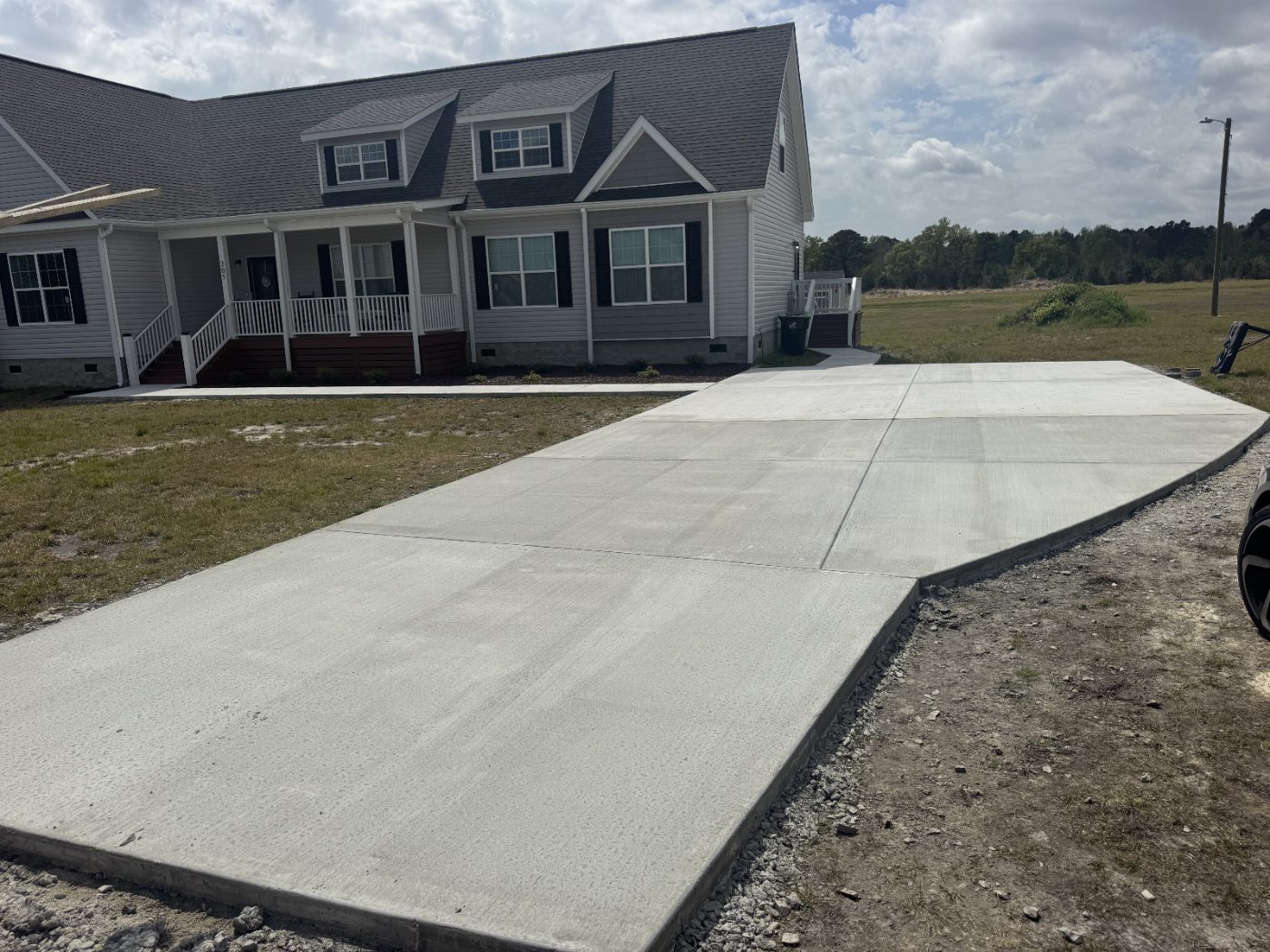
Every week someone asks us for a per-square-foot price on a driveway, and every week we explain why that number would not help them. Two driveways of identical size on the same street can differ by thousands of dollars, and none of that difference is in the concrete itself. It is in what sits underneath it and what has to happen before the truck arrives.
Thickness and reinforcement come first
A four-inch slab over a compacted stone base carries cars and light trucks fine. The moment a work truck, an RV, a boat trailer or a dumpster is part of the picture, that goes to five or six inches with rebar on chairs instead of mesh. That is more concrete, more steel and more labor, and it is not optional. Slabs fail where they were built for a load they never actually get to carry.
Demolition and haul-off
Tearing out an existing driveway means breaking it, loading it and paying to dispose of it. A thick old slab with wire in it takes longer to break and weighs more to haul. Asphalt over concrete is worse. A new drive on virgin ground skips this line entirely, which is why a first-time pour often prices lower than a replacement of the same size.
Excavation, stone and drainage
This is the line that surprises people. Our soils around Wilson, Nash and Johnston counties hold water, and a lot of lots have a foot or more of soft fill near the house from when it was built. If we hit soft ground, it comes out and gets replaced with stone that is compacted in lifts. That work is invisible the day the job is done and it is the difference between a slab that lasts twenty years and one that cracks in three.
- How deep the soft or organic soil goes
- Whether water currently leaves the property or ponds on it
- Whether the drive has to be re-pitched away from the garage or the house
- Whether a drain, a swale or a curb cut has to be part of the work
Access
A truck that can back to the forms and chute directly into place is the cheapest pour there is. If the pour has to be pumped, wheelbarrowed around a house, or staged around a fence, a septic field or a tree you want kept, that is added labor and sometimes added equipment.
Finish, apron and permits
A broom finish is standard and it is what we recommend for nearly every driveway: traction when wet, hides wear, does not fight the house. Stamped or colored work costs more and is better spent on a border, the apron or the front walk. If the drive ties into a public street, the apron may need a right-of-way permit and an inspection, which we handle but which takes calendar time.
How to compare two bids honestly
If one bid is dramatically lower, find out what it left out. Ask each contractor, in writing, for the slab thickness, the reinforcement type and spacing, the base depth and material, the joint layout and who hauls off the dirt. A cheaper bid is often a thinner slab on the existing dirt, and you will not know that until it cracks.